
A school trip scheduled for three weeks from now, a class trip to Barcelona confirmed the day before: suddenly, you’re scrambling to find the right form at the last minute. Cerfa form 15646*01 is the official document authorizing a minor who lives in France to leave the country without being accompanied by someone who holds parental authority. Knowing how to fill it out correctly can prevent problems at the border, including within the European Union.
Cerfa form 15646*01: who actually needs travel authorization for a minor
It’s often assumed that every child traveling abroad needs this form. In reality, it applies to a more specific group. The AST (authorization to leave the country) is required only for minors who usually live in France and are traveling without a parent who holds parental authority.
A child traveling with their father or mother does not need an AST, even if the parents are separated or divorced. The form is required when a minor travels with a grandparent, an uncle or aunt, a language-trip chaperone, or a school supervisor.
Another situation that is often misunderstood: a French minor who usually lives abroad does not need Cerfa form 15646*01 to leave France after a visit or a simple transit. The deciding factor is whether the child usually lives in France. To check which rules apply before filling out the form, E-Nomad’s exclusive guide explains each scenario with practical examples.

How to fill out Cerfa form 15646*01, section by section
The form is available online at service-public.gouv.fr. Fill it out on screen, then download and print it. The document has three sections.
Minor’s identity
Enter the child’s last name, first name, date of birth, and place of birth. The identity document number (national identity card or passport) must exactly match the document the minor will take on the trip. Even a one-digit error can cause problems at the checkpoint.
Signatory’s identity and status
The parent signing the form enters their last name, first name, date of birth, and address. They must state that they hold parental authority over the child. Only one parent needs to sign the AST; there is no need to visit the town hall or have the form approved by a third party.
A photocopy of the signing parent’s identity document must be attached to the form. Make sure the document is valid on the day of departure.
Authorization period
The form lets you set a validity period of up to one year. It can cover a specific trip or a longer period. If a child is taking part in several trips during the year (a school exchange in spring and a summer camp, for example), an AST covering several months means you won’t have to fill out a new form for each trip.
Documents to attach to Cerfa form 15646*01 for travel
The form alone is not enough. On the day of departure, the minor must present a set of documents at border control.
- Completed Cerfa form 15646*01, signed by a parent who holds parental authority.
- A photocopy of the signing parent’s identity document (a valid identity card or passport).
- The minor’s own valid identity document. A national identity card is sufficient for travel to EU countries, but a passport is required for destinations outside the EU.
According to the official Service-Public information sheet, the family record book is not required at border control. Some people include it in the travel documents as a precaution, but it does not replace any of the three documents listed above.
Objections to a minor leaving the country and the limits of the Cerfa form
An AST signed by a parent does not automatically guarantee that the child can travel. If a ban on leaving the country has been imposed by a family court judge or the public prosecutor, Cerfa form 15646*01 cannot override it.
This situation can arise in family disputes where one parent fears an international abduction. The child is then added to the wanted persons database, and their departure is blocked until the ban is lifted through the prescribed administrative procedure.
The distinction between authorization and a ban is clear: an AST facilitates travel for a minor whose parents agree. It does not resolve disputes over parental authority. If the parents disagree, the matter must be taken to a family court judge, not handled using the Cerfa form.
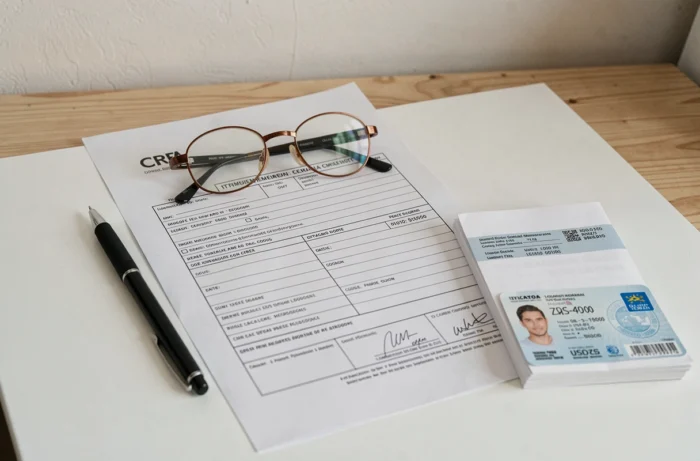
Common mistakes that can cause problems at the border
A few recurring mistakes can lead to a refusal at the checkpoint.
- The minor’s identity document number does not match the document presented (for example, the old number after an identity card has been renewed).
- The signing parent’s photocopied identity document has expired, even though the form is still valid.
- The AST was signed by someone who does not hold parental authority (a stepparent or a guardian who has not been officially appointed).
- The form was printed from the website but not signed by hand.
Checking every document number before printing is the most effective precaution. Compare the completed Cerfa form against the original documents in front of you, one card at a time.
Cerfa form 15646*01 is straightforward, but the parent who signs it is responsible for its contents. It takes only a few minutes to prepare a complete form with the right identity documents. It’s best to do it a week before departure rather than the night before, when you might discover that your child’s identity card expired the previous month.