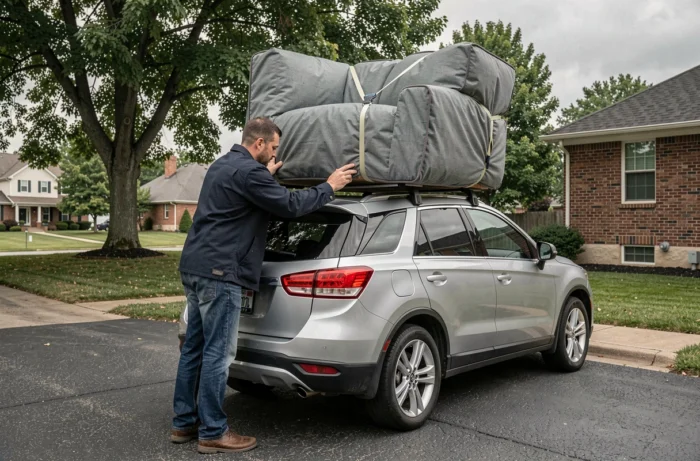
Transporting a sofa in a passenger car means solving a geometry problem before you even lift a cushion. A standard sofa is almost always wider than the usable space in a car boot, and traffic regulations strictly govern overhanging loads, rear visibility and securing cargo. Overlooking any one of these constraints can turn a simple job into a fine or property damage.
Rear visibility and securing the load: requirements a sofa does not exempt you from
Most guides explain how to protect the fabric or remove the legs. Few cover the legal requirements that apply as soon as a bulky piece of furniture is loaded into the passenger compartment.
A sofa placed across the rear seat or wedged against the tailgate can block the rear window. If the exterior mirrors do not make up for this loss of visibility, the vehicle is not roadworthy. Before loading, check from the driver’s seat that the driver has an adequate field of rear vision.
Securing the load is not just a precaution to prevent scratches. Traffic regulations require that a load must not cause damage or danger. A sofa simply placed in the boot or on a folded-down rear seat can become a projectile if you brake suddenly. Two ratchet straps tightened around solid anchor points are the minimum needed to meet this requirement.
If a load extends more than one metre beyond the rear of the vehicle, specific warning signage is required. For a sofa, this means that driving with the boot open and the seat protruding beyond the bodywork is not something to take lightly: a reflective device must be visible both day and night. The safest option is to choose a vehicle that can accommodate the entire piece of furniture inside.
Knowing how to transport a sofa by car starts with checking these regulations, well before choosing protective blankets.
Boot and sofa dimensions: the diagonal that stops everything
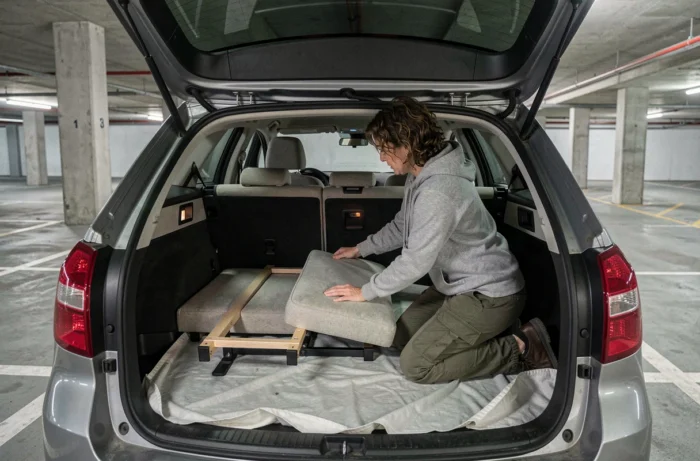
Measuring the sofa’s length and width is not enough. The sofa’s diagonal determines whether it will fit around a stairwell turn, through a doorway or into the boot opening.
Take three measurements of the sofa: overall length, seat depth and backrest height. Then compare them with your vehicle’s actual dimensions, with the rear seats folded down.
- The usable width of the boot, measured between the wheel arches (always less than the width stated by the manufacturer), is the most restrictive limit.
- The height of the tailgate opening determines whether the sofa can be loaded on its side or has to be slid in flat.
- The loading length with the rear seats folded down indicates whether the seat and backrest can fit together without sticking out of the boot.
If the sofa’s diagonal is greater than the diagonal of the narrowest opening along the route (front door, hallway or boot opening), you will need to dismantle it or rule out using a passenger car.
Payload: a less obvious limit than dimensions
The vehicle’s total weight must not exceed the GVW shown on the registration document. In a saloon or estate car, the available payload is often only a few hundred kilos, including occupants. A sofa bed with a metal frame or a corner sofa upholstered in full-grain leather can be heavy. Add the weight of the driver and a passenger, and the remaining capacity quickly shrinks.
This figure appears in field F2 of the registration document. Checking it before moving day helps you avoid overloading, which impairs braking and grip and can also result in a fine.
Dismantling and protecting the sofa before loading it into the car
Dismantling is what can make the move feasible. Removing the legs, cushions and detachable armrests can sometimes reduce a sofa’s depth and height by around ten centimetres, which may be enough to get it through the boot opening.
Keep the screws and fittings in a bag taped directly to the frame. Losing a leg at the end of a move is a classic mishap when transporting furniture privately.
Protect both the sofa and the car. Fabric or leather rubbing against the plastic in the boot can damage both surfaces. Moving blankets secured with stretch wrap protect the corners and contact points. For light-coloured leather upholstery, a layer of stretch wrap directly over the leather prevents colour transfer.
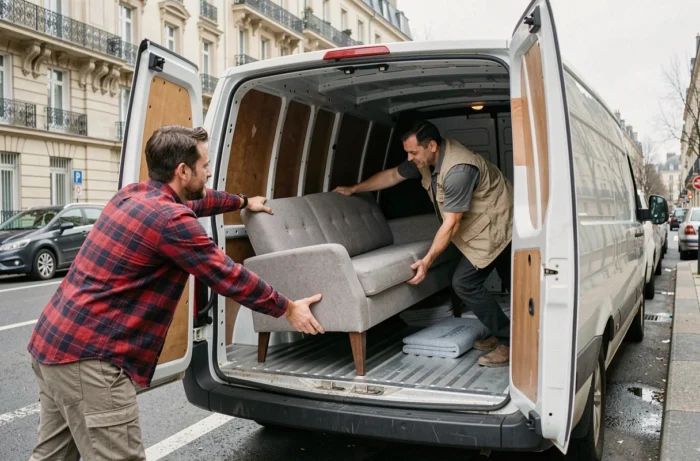
Slide the sofa in on its side (with the backrest facing down) if the opening is high enough. This position takes up less floor space in the boot and leaves room at the sides to wedge the sofa in place. A sofa loaded on its side is also easier to secure with straps passed over it.
Car, van or delivery: choosing the right option for your sofa
A passenger car is suitable when the dismantled sofa fits entirely in the boot with the rear seats folded down, without blocking rear visibility or sticking out beyond the tailgate. If any one of these conditions is not met, forcing the load into the car makes the journey dangerous and could result in a fine.
Renting a van solves the space problem. A van with a few cubic metres of capacity offers much more loading height and width between the wheel arches than an estate car. The rental cost, often reasonable for a few hours, is worth weighing against the risk of damaging a new sofa or your own vehicle.
- A two- or three-seater straight sofa will fit in a large estate car or SUV with its legs removed, provided the boot’s usable width exceeds the seat depth.
- A corner sofa almost always requires a van or dismantling into separate sections.
- A sofa bed with a metal frame is both heavy and bulky: check the payload before considering transporting it by car.
Choose the vehicle before moving day, with a tape measure in hand and the registration document to check. Waiting until you reach the car park to discover that the sofa will not fit is the most common reason this kind of move fails.