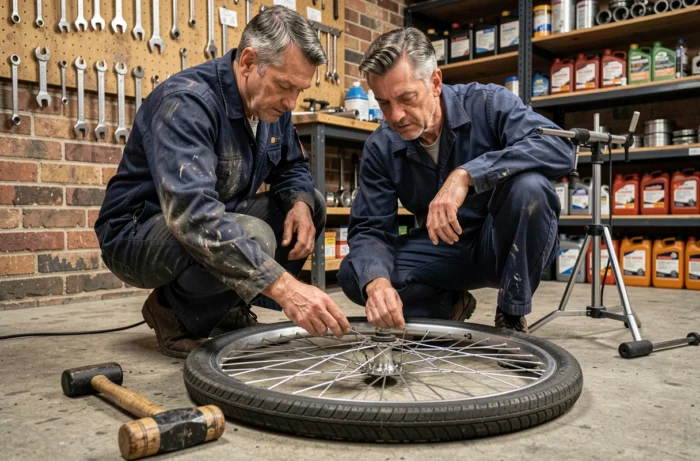
The wheel converts engine torque into linear motion through friction with the ground. This seemingly simple principle relies on an assembly of components, each of whose parameters (stiffness, mass, geometry) affects the vehicle’s dynamic behavior. Understanding how a wheel works means looking beyond a list of parts and examining the physical forces acting on the entire assembly with every rotation.
Rolling resistance and cyclic tire deformation
A tire does not roll on a single point of contact. The vertical load compresses the sidewall and creates an elongated contact area known as the contact patch. With each rotation, the rubber deforms as it enters this area, then returns to its original shape as it leaves.
This deformation is not 100% elastic. Some of the energy dissipates as heat within the tire. This is known as rolling resistance, a parameter measured using standardized methods, although results vary depending on the test surface and protocol used.
This energy loss is especially significant for electric vehicles, as it directly reduces range. We are seeing tire manufacturers work on rubber compounds (silica-to-carbon-black ratios, functionalized polymers) to reduce hysteresis without compromising lateral grip. An article detailing how a wheel works in detail clearly shows how this trade-off shapes the entire design.
The European tire label, mandatory since May 2021, rates rolling resistance from A to E. It also provides information on wet grip and external rolling noise, with a QR code linking to the European EPREL database.

Torque transmission: from the hub to the tread
Engine torque reaches the wheel via the drive shaft, passes through the hub and rim, and is transmitted to the ground through the tire. Every interface in this assembly is a critical point.
Hub and bearings
The hub houses the bearings that allow the wheel to rotate around its axle. A ball bearing supports radial loads, while a tapered roller bearing also withstands the axial forces generated when cornering. Excessive bearing play compromises directional stability and accelerates uneven tire wear.
On modern vehicles, the ABS sensor is integrated into the hub. It reads a toothed ring attached to the bearing to calculate rotational speed. The accuracy of this measurement depends directly on the mechanical condition of the hub.
Rim and structural rigidity
The rim is more than just a tire support. Its width determines the shape of the contact patch, while its offset (ET, from the German Einpresstiefe) changes the lever arm between the wheel center and the steering axis.
- A rim that is too wide for the tire mounted on it stretches the sidewall and reduces comfort, while increasing sensitivity to side impacts.
- Incorrect offset places the bearings outside their rated load range, shortening their service life.
- The material (stamped steel, forged aluminum, cast aluminum) affects unsprung mass, which directly influences the tire’s ability to follow road irregularities.
Driven and steering wheels, and the case of all-wheel drive
Not all of a vehicle’s wheels perform the same function. The distinction between driven and steering wheels shapes the design of the running gear.
A driven wheel receives torque from the powertrain. It must transmit traction without excessive wheelspin. The differential distributes torque between the two wheels on the same axle, allowing them to rotate at different speeds when cornering.
A steering wheel pivots around the steering knuckle axis to guide the vehicle. Steering geometry (caster, camber, toe) determines stability and the steering wheel’s self-centering action. These angles are adjusted to within a tenth of a degree during a wheel alignment.
On a four-wheel-drive vehicle, each wheel performs both functions. A center differential, sometimes supplemented by a viscous coupling or electronically controlled multi-plate clutch, distributes torque between the front and rear axles according to available grip.
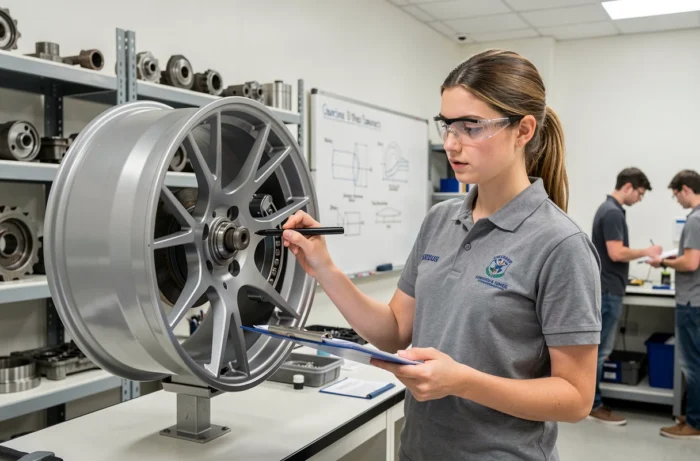
Tire abrasion and Euro 7 regulations
Tire wear is more than an indicator that a tire needs replacing. Rubber particles released through contact between the tire and road are a source of microplastics. They settle on the ground, wash into waterways, or remain suspended in the air.
The Euro 7 regulation, adopted in 2024, introduces tire abrasion limits for the first time. The first requirements for new passenger car tires in category C1 will apply from July 1, 2028. The wheel is therefore becoming subject to regulation beyond its mechanical performance alone.
This requirement is driving manufacturers to rethink rubber compounds. The challenge is twofold: reduce the mass of particles released while maintaining a level of grip that meets safety requirements, particularly on wet roads. Market surveillance results also show that a tire’s real-world performance does not always match the values displayed on its label.
Wheel bolt torque and installation: the often-overlooked parameter
Securing a wheel to the hub may seem straightforward. Yet the tightening torque for wheel bolts or nuts is a value specified by the manufacturer and measured in newton-meters. Insufficient torque can cause the fasteners to gradually loosen, while excessive torque can warp the brake disc or damage the threads.
- Tighten the fasteners in a star (or crisscross) pattern to distribute pressure evenly across the centering surface.
- A torque wrench is the only reliable tool for achieving the specified value.
- After changing a wheel, a follow-up tightening check is recommended after a few hundred kilometers, once the parts have settled.
The wheel remains an assembly in which mechanics, materials chemistry, and now environmental regulations come together with every rotation. Every component affects the others, from the hub bearing to the tread. Reducing the wheel to a rim and a tire means overlooking the essential forces at work between the vehicle and the road.