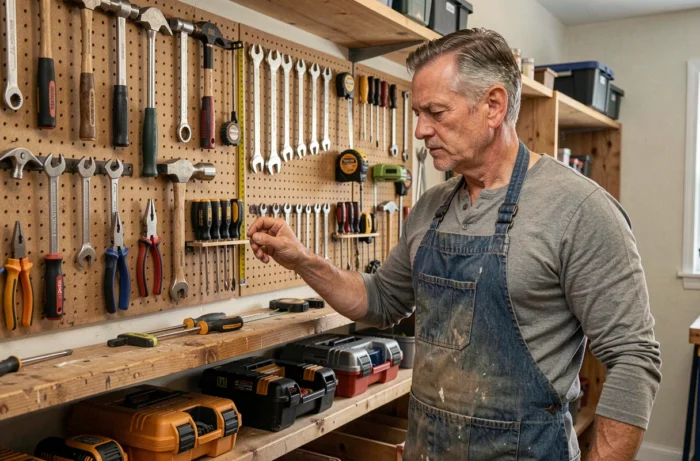
A hole to drill in a stone load-bearing wall, a shelf to mount on drywall, a floating floor to lay over an uneven slab: every home project comes with its own constraints, and the tools you choose depend directly on them. Before filling a toolbox, it pays to identify the planned work and the materials in your home, since using the wrong tool can slow down a project just as easily as it can damage the surface.
Hidden hazards in your home: what to check before buying any tools
People often think of a drill or saw first. In an older home, the real priority is knowing what you’re about to drill into or cut. An apartment built before 1997 may contain asbestos in floor tiles, tile adhesives, ducts or certain spray-on coatings. Paint applied before 1949 may contain lead.
Sanding a wall coated with lead paint without taking precautions spreads toxic dust throughout the room. Cutting into an asbestos-containing suspended ceiling without first having it inspected poses a serious health risk. Identifying these materials before starting any work determines which protective equipment you need and may even mean abandoning the project as a DIY job.
If the home’s technical inspection report (often included in the sale or rental documents) indicates the presence of asbestos or lead, some work is no longer suitable for DIY: it requires a certified asbestos-removal contractor or a containment procedure that homeowners cannot carry out themselves. Recognizing this limit avoids unnecessary spending on tools and, above all, protects your health.
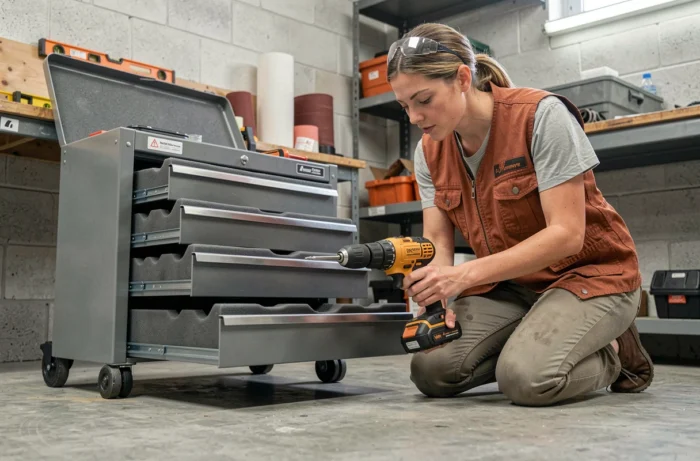
For projects that are safe to tackle yourself, choose protective equipment based on the risks involved. An FFP2 mask is suitable for common wood or plaster dust. Silica dust (from concrete, brick or tile) calls for an FFP3 mask and proper ventilation. Working without dust extraction in an enclosed space remains problematic, even with a good mask.
Hand tools and a drill-driver: build a versatile toolkit for home projects
Once you’ve assessed the risks, you can think about tools. A medium-sized toolbox can cover most household jobs, including mounting, furniture assembly and minor plumbing or electrical repairs. Blog du Bricoleur’s equipment guides take a similar approach, focusing on versatility before specialization.
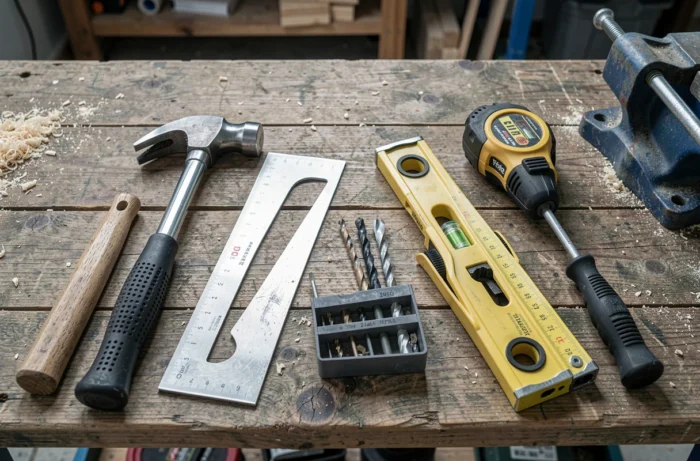
- A set of screwdrivers (flathead and Phillips, with at least three sizes of each) covers furniture assembly, outlet replacement and most everyday adjustments. Interchangeable bits on a single handle are convenient, but a dedicated screwdriver provides better torque on stubborn screws.
- A five-meter tape measure and a spirit level help you measure and align things accurately before fastening them. A mistake of just a few millimeters on a closet track becomes immediately obvious once the doors are installed.
- Slip-joint pliers and an adjustable wrench are enough for working on a sink trap, tightening a fitting or holding a nut while you screw in a bolt from the other side.
- A carpenter’s hammer (with a fiberglass handle rather than a wooden one for greater durability) and a retractable utility knife round out the kit for hammering and light cutting tasks.
A cordless drill-driver is the first power tool to buy. It can drill and drive screws, and models with a hammer function can also tackle brick or lightweight concrete. The key factor isn’t the maximum power rating, but the battery voltage and torque. For regular household use, an 18 V drill-driver with at least 40 Nm of torque will handle most jobs.
Saws, sanders and protective equipment: prioritize based on your projects
Buying a jigsaw, random orbital sander and router all in one day because they were on sale is the best way to end up storing unused tools for years. Buy a power tool when a specific project calls for it, not before.
A jigsaw is the second most useful power tool after a drill. It cuts wood, melamine, PVC and, with the right blade, thin metal. It’s more than adequate for flooring or laminate countertops. A circular saw is only worth considering if you regularly cut full sheets of material or multiple lengths of timber.
A random orbital sander is worth having if you plan to strip a piece of furniture, prepare a wall for painting or smooth out filler. Hand-sanding with a sanding block and sandpaper works on small areas, but becomes tiring and uneven over anything larger than a square meter.
Protective equipment for DIY projects
Safety glasses are not optional. A chip of concrete or metal in your eye while drilling can turn a Saturday DIY project into a trip to the emergency room. Wear them every time you drill, grind, saw or sand.
Gloves suited to the task protect your hands without compromising dexterity. Cut-resistant gloves are suitable for handling sheet metal or glass. Latex or nitrile gloves are useful when working with chemicals (paint stripper, resin). Wearing thick work gloves to drive small screws is counterproductive: you lose precision and have to apply more force.
DIY tool budgets and quality: where to draw the line
You can spot a quality hand tool by looking at practical details. A screwdriver with a chrome-vanadium steel tip holds up better than a low-grade steel one that wears down after just a few screws. Pliers whose jaws no longer line up after six months of use end up costing more than a reputable brand you buy once.
For power tools, an interchangeable battery system lowers the overall cost over time. If you stick with one platform (the same manufacturer and battery voltage), you can buy each additional tool as a “bare tool,” without a battery or charger. The price difference between a complete kit and a bare tool is often around a third of the total cost.
A set of reasonably good hand tools for a versatile starter kit doesn’t require a huge investment. Choose a few reliable tools rather than a 100-piece set, half of which you’ll never use. A good screwdriver, a good pair of pliers and a good tape measure will last for years without needing replacement, provided you store them somewhere dry after use and don’t use them as makeshift levers or chisels.