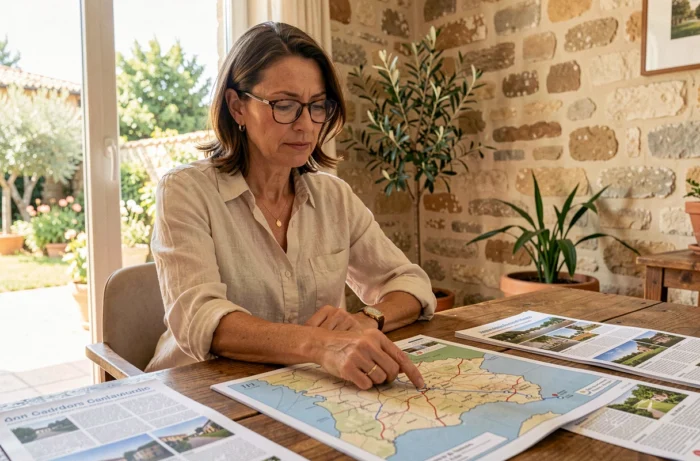
The Gard property market shows considerable differences in prices and returns from one town to another. To spot a genuine opportunity among property listings in the Gard, sorting by price per square metre is not enough: flood risk at the plot level, the property’s energy rating and recent regulatory requirements can significantly affect the true value of a home listed online.
Price differences in the Gard: what the data reveals by area
Property prices in the Gard vary according to a pattern that does not always follow the expected geographical logic. The table below summarises trends observed in the main centres, based on developments reported by notaries and available market analyses.
| Area | Price trend | Market dynamics | Predominant profile |
|---|---|---|---|
| Nîmes city centre | Stable to rising | Transaction volumes increasing | Primary residences, student rentals |
| Uzès and surrounding area | High-end, prices holding firm | International demand | Second homes, prestige properties |
| Le Grau-du-Roi | High (coastal premium) | Strong seasonality | Second homes, furnished holiday rentals |
| Bagnols-sur-Cèze | Affordable | Less competitive market | Primary residences, first-time buyers |
| Beaucaire | Among the lowest in the department | Identified potential for growth | Rental investment |
| Alès | Moderate | Cévennes employment hub | Primary residences |
A low price alone does not make a property an opportunity. Beaucaire has very affordable prices, but actual rental yields depend on vacancy rates and the quality of the housing stock. By contrast, Nîmes has higher prices, offset by strong rental demand throughout the year.
Browsing Ceze property listings shows that the area around Bagnols-sur-Cèze has a concentration of properties priced well below the departmental average, with direct access to routes towards the Rhône Valley.
Flood risk in the Gard: check the plot, not just the town
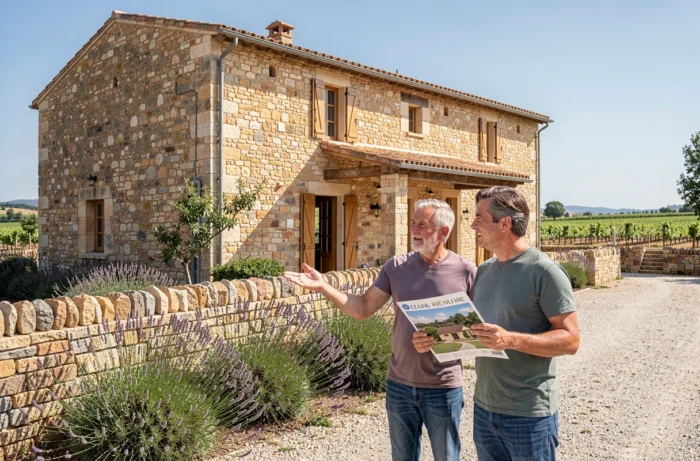
The Gard is one of the French departments most exposed to Cévennes rainfall events. An attractive property listing may be for a home in an area subject to a Flood Risk Prevention Plan (PPRI), which can restrict renovation, extension and construction work.
Checks must be carried out at the individual property level, not just for the town. Two plots on the same street may fall under different PPRI zoning. The Géorisques website lets you check the exposure level of a specific address free of charge.
Since 1 January 2025, property listings have had to explain how to access information about the risks to which a property is exposed. The risk report must be provided from the first viewing. Ask for this document before making the trip: it can reveal restrictions not mentioned in the listing.
- Check the plot’s Géorisques report before any viewing, even if the town does not seem to be at risk.
- Find out whether the property is in a red, blue or white PPRI zone: building and development rules vary significantly between zones.
- Ask the seller or agent for the risk report at first contact, as required by regulations since 2025.
A property listed at a low price in a flood-prone area is not necessarily a bad deal, provided you calculate insurance costs and renovation restrictions before making an offer.
Energy ratings and property listings in the Gard: a regulatory filter not to overlook
A significant share of the Gard’s housing stock consists of older properties, particularly in the town centres of Nîmes, Alès and Uzès. Many of these homes have poor energy ratings.
Since 1 January 2025, homes rated G can no longer be rented out under a new lease, a lease renewal or an extension. F-rated and then E-rated properties will be affected at later dates set out in the law. A listing described as “in need of renovation” or “ideal for investors” may therefore conceal a mandatory waiting period before the property can be rented out.
For a buy-to-let property, the relevant calculation includes the cost of the energy-efficiency upgrades needed to achieve at least an E rating. This budget can turn an apparently cheap property into a loss-making investment in the first few years.
For a primary residence, the situation is different: a poor energy rating can give you leverage to negotiate the purchase price, provided you have had the work costed by a professional before making an offer.

Search strategy: combine criteria to identify genuine opportunities
Property portals let you filter by price, floor area and location. These three criteria are not enough to identify an opportunity in the Gard.
- Cross-check the asking price against the PPRI zoning and energy rating: a cheap property in a flood zone with an F rating has three drawbacks that explain its price.
- Compare the property’s price per square metre with the median for its town, not the whole department: departmental averages conceal differences of several hundred euros per square metre.
- Assess rental potential based on the town’s profile: a university town such as Nîmes generates different demand from a seaside resort such as Le Grau-du-Roi, where returns depend on holiday rentals.
- Check whether the property is subject to a requirement to register as furnished tourist accommodation, which affects tax benefits and the ability to offer short-term rentals in certain towns.
Transaction volumes fell by around 10% in the Gard in 2024, followed by a recovery in the first quarter of 2025, with an increase of a similar scale, according to local notaries. This recovery continued in the spring, with growth of around 8% between April and June. A market in recovery offers more room to negotiate than during the 2021–2022 peaks.
The best indicator of an opportunity is the gap between the asking price and the property’s value once its actual constraints have been taken into account. An apartment in Nîmes listed at market price, with a D rating and a good location, is often a more solid purchase than a heavily discounted house in an area subject to restrictive PPRI rules.
The data speaks for itself: in the Gard, a listing’s quality is measured as much by what it leaves out as by what it shows.