
Parental burnout is measured across three distinct dimensions: physical and emotional exhaustion, emotional distancing from one’s children, and a sense of ineffectiveness in the parenting role. These three dimensions, identified in validation studies of the Parental Burnout Assessment, help distinguish parental burnout from ordinary fatigue or a broader depressive episode. Understanding where the line falls between temporary stress and established burnout means examining each dimension separately.
Parental burnout, postpartum depression and fatigue: what clinical criteria distinguish
| Criterion | Parental fatigue | Parental burnout | Postpartum depression |
|---|---|---|---|
| Duration | Temporary, linked to a specific episode (short nights, illness) | Chronic, persisting for several weeks or months | Variable, often developing in the months after childbirth |
| Scope | Limited to a specific moment | Centered on the parenting role | Affects mood and enjoyment across all areas of life |
| Emotional distancing | Absent | Present: the parent “functions” without emotional involvement | Possible, but linked to a generalized loss of interest |
| Sense of ineffectiveness | Rare | Dominant: feeling no longer capable of raising one’s children | Present, but extends to other areas (work, social life) |
| Recovery after rest | Yes | No, or only partial | No |
This table highlights a point that competitors rarely address with precision: parental burnout and depression can coexist. One does not rule out the other, and a parent can move from parental exhaustion into a depressive episode if the situation persists. Self-diagnosis is insufficient in either case: an assessment by a trained professional (psychologist, psychiatrist, or GP with relevant expertise) can provide an appropriate framework.
To better understand the mechanisms involved, Maman Anonyme’s guide to maternal exhaustion explains the stages that lead from ordinary stress to collapse.
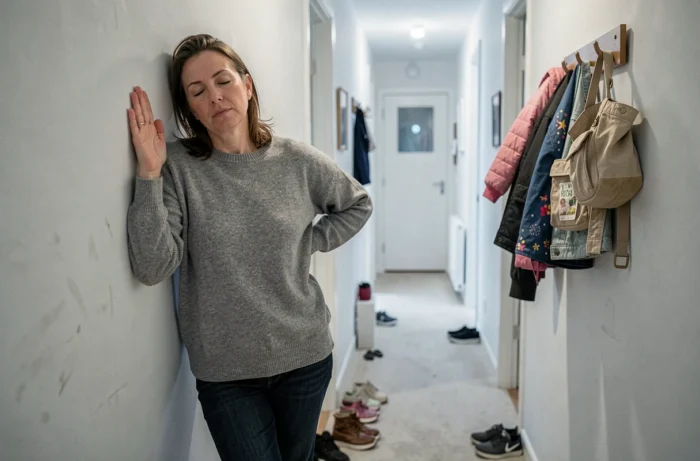
Signs of maternal burnout: signals from the body and behavior
Recognizing burnout is difficult because the early signs resemble ordinary fatigue. The turning point comes when rest no longer restores energy and the parent starts operating on autopilot in interactions with their children.
Persistent physical signs
- Fatigue that does not ease after a full night’s sleep or a restful weekend, with waking up feeling as exhausted as when going to bed
- Recurring muscle tension (neck, jaw, back) and frequent headaches with no identified medical cause
- Paradoxical sleep problems: the parent is exhausted but can no longer fall asleep, or wakes in the middle of the night with intrusive thoughts about family logistics
- Weakened immune system, with repeated infections over several months
Emotional and behavioral signs
The most characteristic sign is no longer enjoying time spent with one’s children. A parent who used to enjoy a trip to the park or a bedtime story but now experiences them as chores to tick off is entering a warning zone.
Disproportionate irritability is another indicator. An intense angry reaction to a spilled drink or the same question being asked three times in a row signals that the threshold for coping with stress has collapsed. This is not a “lack of patience”: it is a nervous system with no reserves left.
Guilt becomes a recurring cycle. The parent blames themselves for no longer feeling spontaneous affection, which worsens emotional exhaustion and, in turn, deepens the emotional distance. This cycle is one of the best-documented mechanisms of parental burnout.
Risk factors for parental burnout: beyond the volume of tasks
Reducing parental burnout to an overload of household chores means overlooking a major risk factor: the pressure to embody a flawless parenting ideal. Research on parental exhaustion finds that parental perfectionism weighs as heavily as, if not more heavily than, the number of hours spent caring for children.
An international study of parents in 42 countries (Roskam et al., Affective Science, 2021) shows that the phenomenon varies across cultural contexts. In societies where intensive parental involvement is strongly expected, the prevalence of parental exhaustion rises, regardless of material resources.
Three circumstances notably increase the risk:
- Social isolation, whether geographical (living far from family) or relational (difficulty delegating, lack of a support network)
- Juggling multiple roles with no breathing space: parent, partner, employee, caregiver, with no room to maintain an identity outside these roles
- The gap between a parent’s expectations of their own parenting and what they manage to do day to day—a gap fueled by social media and conflicting messages about parenting
Parental burnout is not limited to mothers of infants. It also affects parents of older children, teenagers, and fathers. Mothers are statistically more affected because they tend to take on more domestic responsibilities, but no group is immune.

When to seek help for parental exhaustion: warning signs not to ignore
A clear threshold emerges: when going through the motions has lasted for several weeks and the parent no longer enjoys even normally pleasant moments, it is time to seek help. Waiting until you “hit rock bottom” delays treatment and increases the risk of developing depression.
The Parental Burnout Assessment, a scientifically validated tool (Roskam et al., Frontiers in Psychology, 2018), helps professionals measure the severity of exhaustion. It is not a test to take alone online: it is most useful in a clinical setting, where a professional can interpret the results in light of the parent’s history.
A GP is often the first point of contact. They can refer the parent to a psychologist specializing in parenting or, if needed, to a psychiatrist if depressive symptoms are also present. Treatment generally combines psychotherapy with practical work on sharing responsibilities and reducing guilt.
Parental burnout can be identified across three measurable dimensions, distinguished from depression by its connection to the parenting role, and addressed with structured support. Parental perfectionism remains the least visible and most influential risk factor.