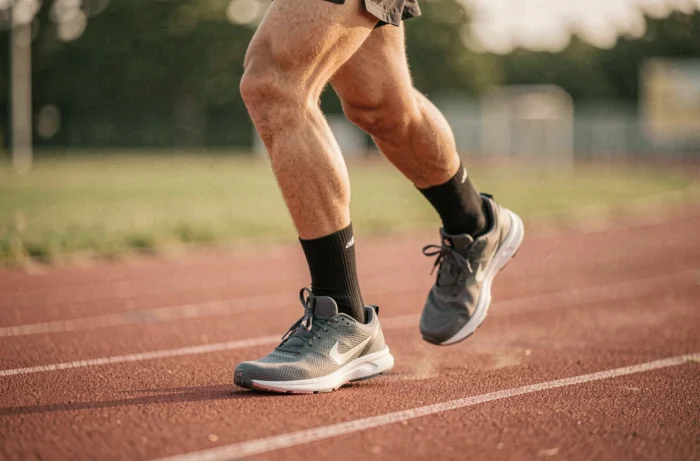
Pronation and supination are two natural rotations of the foot as it makes contact with the ground. Pronation is a roll inward, while supination shifts the weight toward the outer edge of the foot. Both movements occur with every stride in all runners and walkers, helping absorb the impact transmitted to the joints.
Running form and fatigue: why a one-off analysis isn’t enough
Most running gait analyses take place over just a few minutes, in a store or clinic. The runner is rested and focused, so their mechanics rarely reflect what happens at mile thirty of a long run.
Running form observed at a single point in time can change significantly as muscle fatigue sets in. Cadence slows, hip control deteriorates, and asymmetries emerge between the left and right foot. If pain tends to occur toward the end of a run, a gait analysis performed at rest may miss the real problem.
Understanding pronation and supination in sports therefore means looking beyond the snapshot provided by an in-store test. Observing your gait over different distances and at different paces gives you a much more reliable picture of how you actually move.
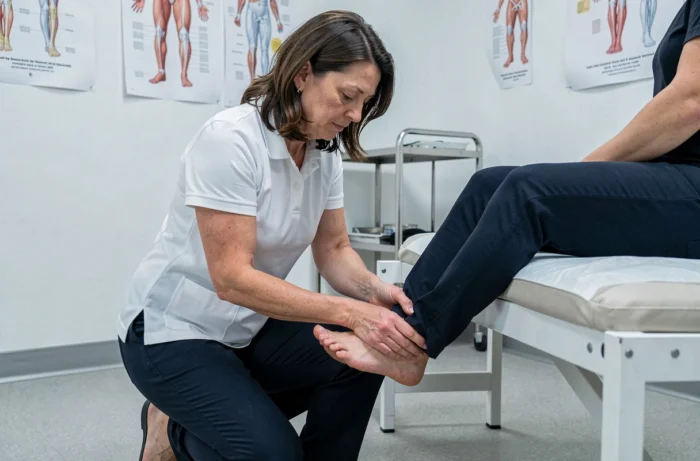
Pronation, overpronation and supination: what each movement means for the foot
When the foot rolls inward during the stance phase, this is called pronation. Some degree of pronation is normal and even beneficial: it helps the foot absorb impact and adapt to the terrain. The problem begins when this inward roll becomes excessive, a condition known as overpronation.
Overpronation places disproportionate stress on the inner edge of the foot and can affect knee alignment. It is often indicated by uneven wear on the sole, which is more pronounced along the inner heel and forefoot.
Supination (or underpronation) is the opposite movement. The weight stays concentrated on the outer edge of the foot. This pattern is less common than overpronation. In this case, sole wear is concentrated along the outer edge. The stiffness of a supinating foot reduces its natural shock-absorbing capacity, which can increase stress on the ankle and shin.
How to identify your gait type without equipment
- Check the wear on your athletic shoes after several weeks of use: wear on the inside (overpronation), wear on the outside (supination), or centered wear (neutral gait)
- Try a wet footprint test by placing your wet foot on a sheet of kraft paper: a broad print with little visible arch suggests a pronating foot, while a narrow print with a pronounced arch points to supination
- Film yourself running from behind on a treadmill to observe your ankle angle as your foot lands
Pronation and weight training: how supinated and pronated grips work the arms
In weight training, the terms pronation and supination refer to rotation of the forearm, not the foot. The difference is simple: palm facing down (pronation), palm facing up (supination). Changing your grip can significantly alter which muscles are engaged during the same exercise.
A supinated grip recruits more of the biceps brachii. This is the case with standard curls and chin-ups, where the biceps works in its strongest position. The brachioradialis also comes into play, but in a secondary role.
With a pronated grip, the emphasis shifts to the brachioradialis and the forearm extensors. Pull-ups engage the latissimus dorsi more than chin-ups, with less contribution from the biceps. A neutral grip (palms facing each other) offers a middle ground, distributing the work between these muscle groups.
Choose your grip to match your training goals
To target biceps size, supinated exercises such as dumbbell curls and chin-ups are more direct. To build grip strength and forearm muscles, pronated exercises such as reverse curls or strict pull-ups provide a stimulus that supination alone does not.
Alternating grips between workouts helps train the entire arm and forearm chain without creating imbalances. A program that uses only one wrist position can eventually underdevelop the opposing muscles.
Running shoes and gait type: what the research really shows
A common belief is that runners who overpronate should wear motion-control shoes, while supinators need a highly cushioned model. The scientific picture is more nuanced.
Choosing shoes based solely on the shape of your arch has not been shown to clearly prevent injuries. Motion-control shoes may be useful in certain specific cases, but they are not a one-size-fits-all solution for everyone who pronates.
Likewise, pronation alone cannot reliably predict whether an injury will occur. Systematic reviews of biomechanical risk factors for running injuries report conflicting findings across the populations studied.
- Comfort during the fitting remains a useful criterion: runners who feel comfortable in their shoes tend to adopt a more relaxed stride
- Heel-to-toe drop (the height difference between the heel and forefoot) has a greater influence on how stress is distributed than the “stability” or “neutral” category shown on the box
- Personalized advice from a podiatrist is more useful than a generic guide based solely on gait type
Current research points toward an individualized approach, in which injury history, training volume and muscle strength matter just as much as the degree of pronation. A pronating foot is not a diseased foot, and routinely correcting a natural movement can cause more problems than it solves.